

Introduction: The Need for Hazardous Area Controls
Imagine working where the air itself could explode. In oil refineries, chemical plants, mines, and pharmaceutical facilities, flammable gases, vapors, or combustible dust create explosive atmospheres that a single spark could ignite. Hazardous area controls are specialized systems engineered to operate safely in these environments by eliminating all potential ignition sources. Every sensor, switch, and wire must meet strict international standards, such as IECEx, ATEX, and NEC. This article examines how industries identify danger zones, implement protective measures such as explosion-proof enclosures and intrinsically safe systems. It also covers how to utilize modern automation to enhance both safety and operational efficiency in explosive environments.
Understanding Hazardous Area Classifications
Before installing equipment in explosive environments, engineers must determine the explosion risk level. Hazardous area classification systematically maps danger zones, identifying where explosive atmospheres form and their frequency. This classification directly dictates which certified control equipment can safely operate in each zone.
Classification Systems
Two major systems dominate global industrial safety standards. The IECEx and ATEX systems, used internationally and in Europe, classify areas into zones based on risk levels.
For flammable gases and vapors:
- Zone 0: Explosive atmospheres present continuously, such as inside storage tanks or processing vessels.
- Zone 1: Explosive atmospheres are typically present during normal operations. For instance, areas around tank filling points, pump seals, vents, or hatches, like in the image below.
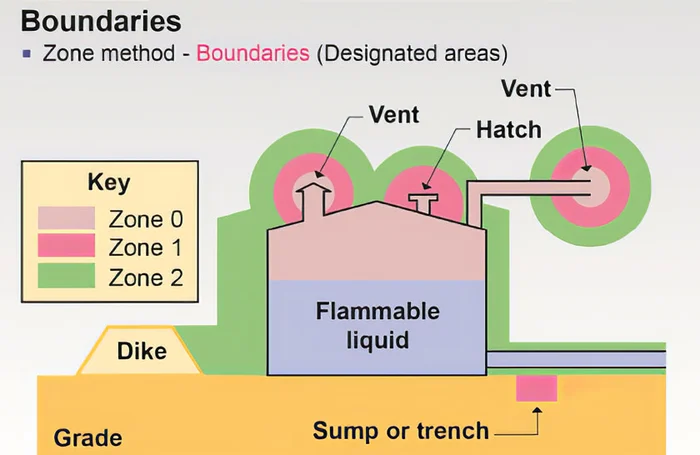
- Zone 2: Explosive atmospheres are rare, occurring during only abnormal conditions such as equipment failures or leaks.
For combustible dust:
- Zone 20: Explosive dust clouds present continuously, typically inside dust collectors, silos, or cyclones.
- Zone 21: Explosive dust clouds are likely during normal operations around bag-filling stations or conveyor transfer points.
- Zone 22: Explosive dust clouds are unlikely except during equipment malfunctions. With regular cleaning, the dust never accumulates enough to form explosive concentrations in the air.
North America follows the NEC Class and Division system:
- Class I: Locations with flammable gases and vapors.
- Class II: Locations with combustible dust.
- Class III: Locations with ignitable fibers like textile mills.
- Division 1: Hazardous materials present during normal operations.
- Division 2: Hazardous materials present only during abnormal or failure conditions.
Factors Influencing Classification
Engineers evaluate critical factors when classifying hazardous areas:
- Frequency and duration: Does the hazard exist continuously, occasionally, or rarely? Daily valve leaks pose a greater risk than annual occurrences.
- Material characteristics: Each substance behaves uniquely. Natural gas ignites differently from diesel vapor. Fine aluminum dust reacts differently from coarse wood dust.
- Operating temperature: Higher temperatures increase vaporization and explosion risk. Hot processes generate more hazardous vapors than cold operations.
- Ventilation effectiveness: Good airflow dilutes dangerous concentrations to safe levels. Poor ventilation allows flammable mixtures to accumulate in enclosed spaces.
- Release rate and quantity: Small, slow leaks present less risk than large, rapid releases of flammable material.
Why Classification Matters to Hazardous Area Controls
Proper classification has direct, practical consequences for facility safety and operations:
- Equipment selection: A sensor rated for Zone 2 cannot legally operate in Zone 0. Each zone requires specific protection levels and certifications.
- Installation requirements: Cable types, conduit systems, and sealing methods differ dramatically between zones. Zone 0 demands the most rigorous protection.
- Maintenance procedures: Technicians must follow zone-specific protocols. Opening a junction box in Zone 1 requires different precautions than in Zone 2.
- Worker safety: Correct classification ensures equipment cannot become an ignition source, protecting personnel from explosions and fires.
- Regulatory compliance: Proper classification prevents legal violations, costly facility shutdowns, insurance issues, and potential criminal liability after incidents.
- Cost optimization: Overclassifying areas forces expensive equipment choices unnecessarily. Accurate classification balances safety with practical economics.
Design Principles for Hazardous Area Control Systems
Designing control systems for explosive environments requires eliminating every potential ignition source. Safety considerations override conventional design choices, demanding meticulous planning at every stage.
Source Control
Three primary threats cause ignition in hazardous areas:
- Electrical arcs: Tiny sparks occur when circuits switch on or off, carrying enough energy to trigger explosions.
- Static discharge: Energy builds on surfaces and releases suddenly, like the shock from touching metal after walking on carpet.
- Hot surfaces: Overheated components, motors, or light bulbs can exceed ignition temperatures for flammable materials.
The solution is energy limitation. Engineers design circuits incapable of releasing enough energy to cause ignition, even during failures. They calculate maximum voltage, current, and stored energy, ensuring totals remain below ignition thresholds for specific gases or dusts.
Environmental Protection
Beyond explosion risks, equipment must withstand harsh industrial conditions:
- Enclosure ratings: IP and NEMA standards define protection levels. IP66 enclosures seal against dust and withstand high-pressure water jets.
- Corrosion resistance: Stainless steel 316, protective coatings, or reinforced polymers resist chemical attacks.
- Temperature control: Cooling fins or ventilation prevent dangerous internal heat buildup.
Redundancy and Reliability
Equipment failures in hazardous areas create safety risks beyond downtime. Redundancy means building backup systems that take over automatically when primary systems fail.
Key redundancy strategies include:
- Redundant power supplies: Two independent power sources feed critical equipment. If one fails, the backup activates instantly without interruption.
- Dual communication networks: Separate cables or wireless links ensure operators maintain monitoring and control even if one path breaks.
- Fail-safe design: Controllers automatically move processes to safe shutdown states when sensors fail or communication drops.
- Continuous diagnostics: Equipment monitors its own health, detecting weak batteries, failing components, or degraded performance. Early warnings enable scheduled maintenance during planned shutdowns rather than emergency repairs in active hazardous zones.
Protection Techniques for Hazardous Areas
Intrinsic Safety (IS)
Intrinsic safety ensures equipment cannot ignite flammable atmospheres under any condition, including failures. Barriers use resistors, fuses, and diodes to limit electrical energy below ignition levels, even during complete wiring shorts. IS suits low power instrumentation like sensors and transmitters. Technicians can maintain IS circuits in live hazardous areas without special permits, though power limitations restrict use to small devices.
Explosion Proof / Flameproof Enclosures
Heavy metal enclosures with thick cast walls contain internal explosions. Precisely machined gaps allow explosion gases to escape slowly, cooling flames below ignition temperature before reaching the outside atmosphere.
Certifications like Ex d (IECEx designation for flameproof enclosures) or Class I Division 1 verify protection for motor starters, switches, and junction boxes. Trade-offs include significant weight, high cost, and complex installation.
Purge and Pressurization Systems
Purge and pressurization systems pump clean air or inert gas continuously into equipment enclosures, creating a higher internal pressure that prevents explosive atmospheres from entering. This allows standard commercial equipment to operate safely in hazardous zones. Automatic shutdown activates if pressure drops. Applications include analyzer shelters, control rooms, and large panels, where explosion-proof alternatives are prohibitively expensive
Role of Automation and Control in Risk Mitigation
Modern automation technologies transform hazardous area safety from passive protection to active intelligence. Smart control systems not only prevent ignition, they also optimize operations while reducing human exposure to dangerous zones.
Remote I/O and Distributed Architectures
Remote I/O stations place intelligent modules near field devices, minimizing wiring through hazardous zones. Fewer cables reduce failure points and installation costs. Technicians perform maintenance on remotely located equipment in safe areas rather than entering explosive atmospheres. Distributed architectures enable modular expansion without system redesigns.
Intrinsically Safe PLCs and Control Hardware
Modern PLCs feature built-in intrinsic safety, connecting directly to field sensors in Zone 1 or Division 1 areas without external barriers. Real-time monitoring detects faults instantly, isolating problems before escalation. Modular designs allow capacity additions or component replacements without shutdowns. Advanced diagnostics predict degradation, enabling proactive maintenance scheduling.
Integration with Safety Instrumented Systems (SIS)
Hazardous area controls integrate with SIS to achieve the required Safety Integrity Levels. SIS provides independent protection that intervenes automatically during dangerous deviations. Standards IEC 61508 and IEC 61511 define rigorous design, installation, and testing requirements, ensuring facilities meet quantified safety targets.
Key Challenges in Hazardous Area Design
Despite advanced technologies, designers face persistent challenges:
- Safety versus performance trade-offs: Maximum protection often limits processing speed, communication bandwidth, or device functionality. Finding an optimal balance requires deep application knowledge.
- Environmental extremes: Equipment must withstand temperature swings from arctic cold to desert heat, coastal salt spray, and corrosive chemical atmospheres simultaneously.
- Certification maintenance: System upgrades or component replacements can void certifications. Every modification requires recertification, creating lengthy approval processes.
- Cybersecurity vulnerabilities: Connected industrial systems face increasing cyber threats. Intrinsically safe networks still need protection against unauthorized access that could manipulate safety-critical parameters.
Best Practices for Safe and Compliant Hazardous Area Controls
Designing robust hazardous area systems requires disciplined engineering practices:
- Start with a comprehensive risk assessment: Conduct HAZOP (Hazard and Operability Study) and LOPA (Layer of Protection Analysis) to identify all potential ignition scenarios systematically.
- Specify certified components only: Select equipment from manufacturers with proven IECEx, ATEX, or NEC certifications. Avoid uncertified substitutes regardless of cost savings.
- Establish preventive maintenance programs: Schedule regular inspections of enclosures, barriers, and protective systems before failures occur.
- Maintain rigorous documentation: Record all design decisions, modifications, and certifications. Traceability is essential for compliance audits and incident investigations.
How Petrotech Designs for Hazardous Area Safety
At Petrotech, we specialize in engineering control systems for the most challenging explosive environments. Our expertise includes explosion-proof and intrinsically safe solutions fully compliant with IECEx, ATEX, and NEC standards.
Our experience spans diverse applications, including compressor stations, refineries, offshore platforms, and chemical plants. We deliver turnkey services covering complete project lifecycles: conceptual design, detailed engineering, panel fabrication, rigorous factory testing, site installation, and full certification support. This integrated approach ensures systems meet both safety requirements and operational performance from day one.
Contact us today to discuss how Petrotech can deliver compliant, reliable control solutions for your hazardous area applications.