
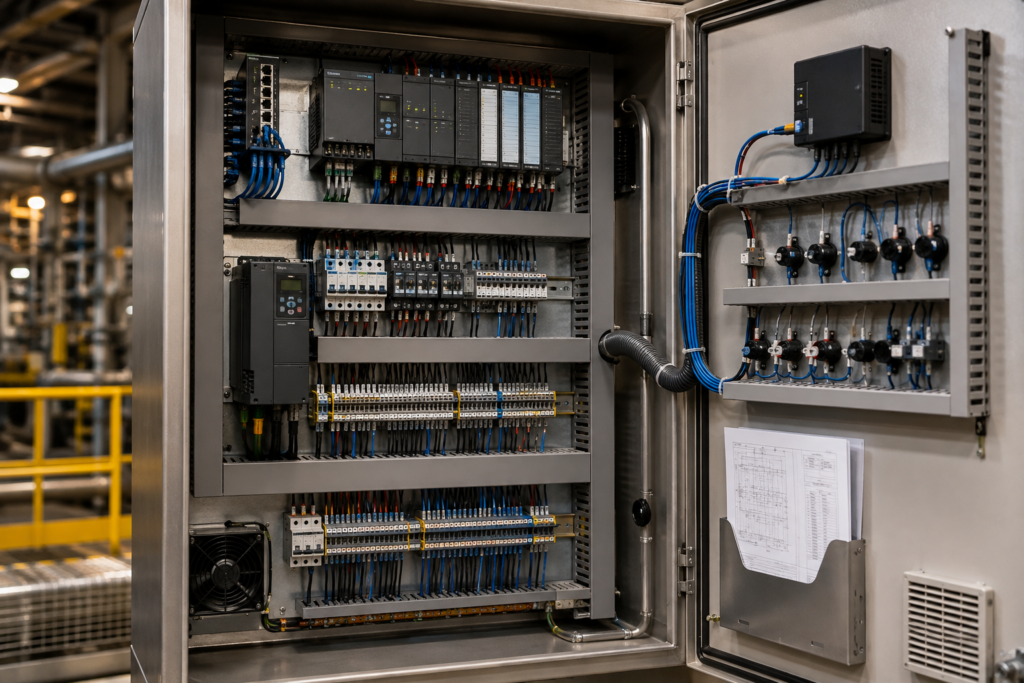
Industrial control panel design becomes more demanding when equipment must operate in harsh industrial environments. High temperatures, vibration, moisture, dust, corrosive exposure, and difficult field conditions can affect component life, wiring integrity, and long-term system reliability. For reliability teams, evaluating a control panel means looking beyond the enclosure itself. Thermal management, vibration resistance, wiring practices, environmental protection, documentation, and maintainability all affect how reliably the panel performs over its service life. This guide outlines the key control panel design considerations reliability teams should evaluate when specifying, reviewing, or maintaining panels for refineries, offshore facilities, remote installations, and other demanding industrial environments.
Key Control Panel Design Considerations for Harsh Environments
A reliable industrial control panel depends on more than enclosure strength. Reliability teams should evaluate six core areas: thermal management, vibration and shock resistance, wiring integrity, environmental protection, documentation, and field maintainability. Each directly affects panel reliability, service life, and the ability to troubleshoot or repair equipment under demanding operating conditions.
Thermal Management and Control Panel Cooling
Temperature is a critical factor in industrial control panel reliability. Electrical and electronic components generate heat during operation, and that heat can accumulate inside sealed enclosures. Factors such as high ambient temperatures, direct solar exposure, nearby process equipment, and inadequate ventilation can push internal panel temperatures beyond component operating limits, accelerating component degradation and increasing the risk of unplanned shutdowns.
Low temperatures and high humidity create a different concern: condensation. When moisture forms inside the enclosure, it can contribute to corrosion, insulation degradation, and electrical faults. Effective thermal management therefore requires planning for both heat removal and condensation prevention.
Reliability teams should evaluate:
- Site temperature range: Account for normal operating conditions as well as seasonal and short-term temperature extremes.
- Internal heat load: Consider the heat generated by power supplies, drives, controllers, relays, and other installed components.
- Cooling method: Determine whether passive ventilation, filtered fans, enclosure air conditioning, or air-to-air heat exchangers are appropriate for the environment.
- Component placement: Keep temperature-sensitive devices away from major heat-producing components and maintain adequate spacing for airflow.
- Condensation control: Evaluate enclosure heaters or other humidity-control measures where low temperatures or high humidity increase condensation risk.
The cooling strategy should be based on actual site conditions and calculated panel heat load rather than average ambient temperature alone.
Vibration and Shock Resistance
Pumps, compressors, and vehicle traffic create constant vibration near many industrial panels. Over time, this shaking loosens terminal connections and cracks solder joints, a problem engineers call vibration fatigue. Reliability teams should ask whether internal components are braced and whether the enclosure can absorb shock without harming sensitive electronics.
Evaluation criteria for vibration and shock resistance include:
- Mechanical bracing for components in high vibration zones
- Shock-rated mounting hardware and vibration-dampening pads
- Enclosure gaskets that stay sealed even under continuous movement
- Cooling equipment carrying a vibration rating suited to the site
Wiring Integrity and Control Panel Reliability
Wiring is the circulatory system of a control panel, and even small wiring errors can cause major failures. Loose connections generate heat, misidentified wires slow down repairs, and unprotected cable runs wear through insulation over time. Every wire should carry a clear label at both ends so technicians can trace circuits without guesswork.
Clear labeling is widely regarded as the single most important habit for maintainable wiring.
Reliability teams should look for:
- Consistent wire numbering that matches the panel schematic
- Terminal strip identification for fast fault finding during a live outage
- Strain relief and careful cable routing away from sharp edges and heat sources
- Periodic continuity testing to catch degrading connections early
Environmental Exposure: Dust, Moisture, and Corrosive Gases
The enclosure is the first line of defense against the outside world. In North America, this protection is measured using NEMA ratings. NEMA ratings are a classification system describing how well an enclosure keeps out dust, water, and corrosive substances. A similar system called the IP rating serves the same purpose internationally.
A NEMA 4 rated enclosure, for example, must withstand a direct, hose-delivered water spray from close range. No moisture can reach the components inside. A NEMA 4X enclosure meets that same test and adds resistance to rust and corrosion.
Offshore platforms and coastal facilities add another challenge, since salt spray and corrosive gases attack unprotected metal quickly. Stainless steel enclosures with protective coatings resist this damage far longer than standard painted steel.
Reliability teams should confirm:
- Enclosure rating matched to actual site conditions, not just a general industrial label
- Corrosion-resistant materials such as stainless steel or coated aluminum for coastal and offshore sites
- Sealed cable entries and gaskets that prevent dust and moisture ingress
- Filtration or purge systems in areas with fine airborne particles or combustible dust
Control Panel Documentation and Compliance
Good documentation protects a facility long after the original engineers have moved on. In the United States, UL 508A is the leading safety standard for industrial control panels, covering component selection, wiring methods, and labeling. Complete documentation should travel with the panel for its entire service life, not just during installation.
A strong documentation package includes:
- Up-to-date schematics and wiring diagrams stored with the panel.
- Component lists with part numbers to speed up replacement.
- Test and inspection records showing a clear compliance history.
- Labeling throughout the panel that matches the documentation exactly.
Maintainability in the Field
A control panel is not a one-time purchase. Many panels stay in service for 20 years or longer, so reliability teams must plan for years of inspections, repairs, and upgrades. Panels that are hard to access or poorly labeled slow down every repair, and slow repairs mean more downtime.
Planning for maintainability at the design stage saves significant time and money over the life of the panel. Reliability teams should look for:
- Enough working space and lighting inside the enclosure for safe servicing
- Touch-safe components that reduce risk during live inspections
- Extra room for future expansion without a full panel redesign
- Clear, durable labels that survive years of heat, dust, and handling
How to Evaluate an Industrial Control Panel for a Harsh Environment
Reliability teams do not need to be electrical engineers to evaluate a proposed panel design. The following steps offer a practical way to review a new design or audit a control panel already in service.
- Map the operating environment. Record the temperature range, humidity, dust levels, and any chemical exposure at the exact installation site.
- Match the enclosure rating to the site. Choose a NEMA- or IP-rated enclosure suited to those conditions, not a generic industrial rating.
- Confirm the cooling plan. Verify that the heat load calculation and chosen cooling method can handle peak temperatures, not just average temperatures.
- Check vibration and shock protection. Ask for bracing, dampening hardware, and vibration-rated cooling equipment in any high-vibration area.
- Review wiring and labeling. Request the wire numbering system and labeling standard used throughout the panel before approving the design.
- Verify documentation and compliance. Confirm UL 508A listing where applicable, along with complete schematics and test records.
- Assess field maintainability. Walk through service access, spare part availability, and room for expansion before signing off on the design.
Build Lasting Reliability with Petrotech
Designing a control panel for harsh industrial environments means planning for heat, vibration, and wiring integrity from day one. It also means planning for environmental exposure, documentation, and long-term maintainability. Reliability teams that evaluate these factors early avoid costly failures, unplanned downtime, and safety risks down the road.
At Petrotech, we design and build control panels engineered for the toughest industrial conditions. Our panels serve sites from offshore platforms to remote well installations. Our team works closely with reliability engineers to match every panel to its real-world environment, not just a general industrial standard.
Contact us today to discuss your next control panel project.